The Proposed Administrative Complex in Barja: Is This Really the Right Site? Seven Questions Before the Choice Is Settled
Does Barja Need a New Administrative Complex?
There is no doubt that Barja needs to develop its administrative and service facilities in a manner that keeps pace with its population size and its growing role in the region. Some of the official administrations operating there today occupy cramped buildings or offices that do not meet the requirements of modern work, while the dispersal of services across more than one location imposes additional burdens on citizens completing their transactions.
From this standpoint, the idea of establishing an administrative complex bringing together a number of public administrations and institutions in a single location seems, in principle, a legitimate and needed idea, since it could help improve services, make them easier for citizens to access, and secure better working conditions for the administrations concerned.
Yet the importance of the project also demands making sure that the decisions associated with it have been taken on sound and well-considered grounds, particularly with regard to the choice of its site. The question posed today is not the need for the administrative complex, but rather whether the proposed site is in fact the most suitable one, and the one most consistent with the public interest and with the requirements of sound urban planning.
Were Criteria Set for Choosing the Site?
When it comes to a strategic public project meant to serve the town for decades to come, the first question should not be "Where shall we build?" but rather "What specifications should the required site possess?"
Clear criteria for selection should therefore have been defined first — such as ease of access, a central location, the possibility of future expansion, cost, and environmental considerations — after which available properties and sites could be compared on the basis of these criteria. Choosing a specific site from the outset, without presenting the alternatives and the reasons for excluding them, makes it difficult to verify that the option adopted is indeed the best and most suitable for the public interest.
Where Is the Proposed Property Located, and What Are Its Characteristics?
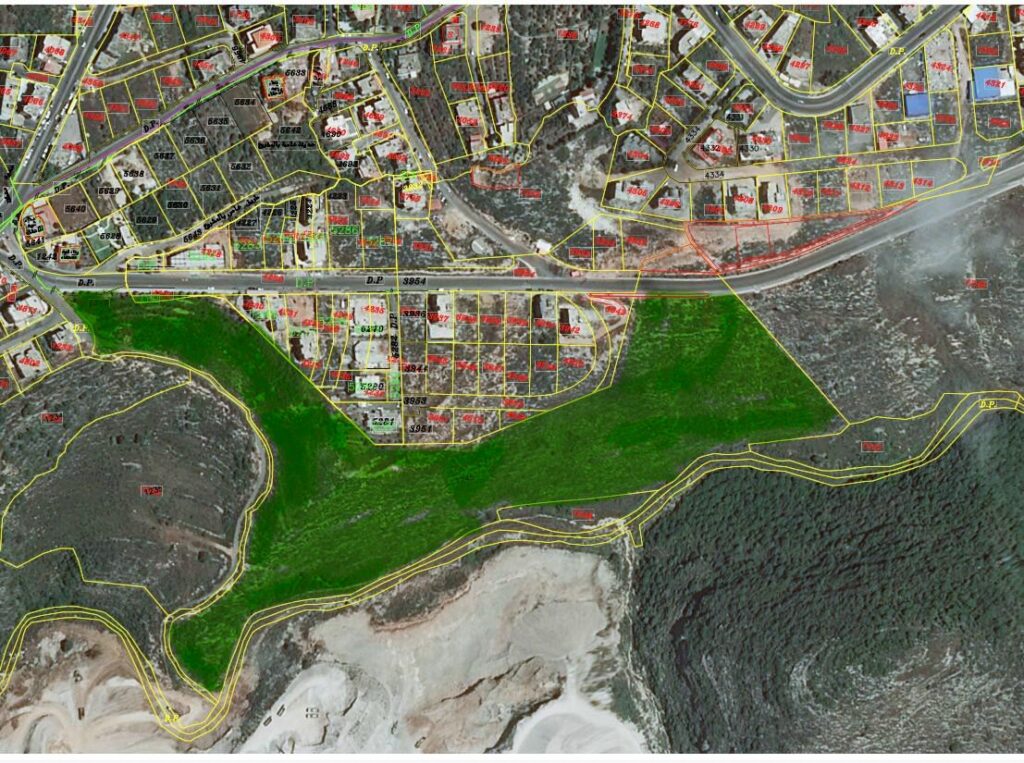
The proposed project is located on plot No. 1245 in the Barja cadastral zone, a property described in the land registry as an old commons (musha') designated for the grazing of the town's residents' livestock. It covers tens of thousands of square metres, making it one of the largest remaining commons properties in Barja.
The property lies at the town's southwestern edge, on its boundary with the town of Sibline, far from the centre of the main built-up area. On its opposite side, it also borders an area that has for years been exploited for quarrying and building-materials production, with the attendant truck traffic, dust, and well-known environmental impacts.
The importance of the site is not confined to its being a vast commons; it is also bound up with its geographic nature, since it is marked by pronounced slopes and an open, natural character that for decades has remained untouched by dense urban expansion.
Have the Available Alternatives Been Reviewed?
If the need for a new administrative complex is taken as a given, the next natural question is: why was this particular site chosen?
Municipalities do not own a single property; they typically hold a range of properties and commons that differ in location, area, and investment potential. It should therefore have been the case that any practical step was preceded by an inventory of municipal properties and usable commons, followed by an evaluation of candidate sites according to clear, published criteria.
It is not yet known whether the municipality has prepared a study comparing several potential sites, or whether it has presented the reasons that led it to prefer the proposed property over others. Nor have any criteria or results been published that would allow citizens or specialists to understand the basis on which this choice was made.
In truth, the suitability of any site cannot be assessed in the abstract, but only by comparing it against other alternatives that may be more central, more environmentally appropriate, or less costly in terms of development and investment.
Is the Proposed Property Suited to the Function of an Administrative Complex?
Setting aside other aspects related to the project, plot No. 1245 poses a set of practical challenges connected to its geographic nature and location — elements that should be taken into account in assessing its suitability to host an administrative complex expected to receive, on a daily basis, large numbers of citizens, visitors, and employees.
The property lies at the town's southwestern edge, relatively far from the centre of population and urban density, which limits ease of access for a broad segment of residents compared with other, more central sites.
The site is also marked by pronounced natural slopes, meaning that erecting a large administrative building — with the plazas, walkways, services, and infrastructure it requires — would call for grading, filling, and retaining-wall works at a relatively high cost compared with flatter sites.
In addition, the shape of the property itself does not lend itself well to accommodating a project of this kind. Its boundaries are irregular, and large portions of it take the form of relatively narrow strips and corridors, which reduces the flexibility of distributing buildings, facilities, and supporting services within the site.
The question of parking stands out in particular, being one of the essential elements of any modern administrative complex. The proposed complex is expected to receive employees and visitors from across the town and the wider area, requiring that a sufficient number of parking spaces be secured within the property itself. If this proves impossible because of the site's nature and shape, the problem may simply be shifted onto the public road and the surrounding area rather than being resolved.
This raises a legitimate question: does plot No. 1245 offer the best functional and logistical conditions for an administrative complex meant to serve the town for decades to come, or are there other sites more suitable in terms of shape, topography, ease of access, and capacity to accommodate car and visitor traffic?
Would Environmental Protection Be the Best Investment for This Commons?
If plot No. 1245 constitutes one of the largest remaining commons in Barja, the question is not limited to what can be built upon it, but extends to what ought to be preserved within it.
The area faces a zone already suffering environmental impacts from quarrying and building-materials production, which lends it added value as an open space that could play an important environmental role for the town. Its sloping nature and non-urban character also make it more suited to environmental and natural uses than to structural expansion.
From this standpoint, it may be worth considering afforestation of these spaces and their gradual conversion into a municipal forest or a public natural park, forming a green lung for the town and an environmental buffer that mitigates the effects of pollution and dust coming from neighbouring areas.
Raising this option does not mean excluding any other use in advance, but it does require that it be included among the alternatives studied and compared before a final decision is taken on the future of this property.
Is It Time to Revisit a Planning Choice a Quarter of a Century Old?
The debate underway today over plot No. 1245 may well open the door to a broader question than merely choosing a site for an administrative complex — namely, the question of the future of this area itself.
It is worth recalling that this area was not classified, in the first draft of Barja's master plan, among the zones eligible for urban expansion; rather, it was classified under the category of "valleys" (wetlands/ravines), one of the most restricted categories in terms of building and development. At the time, it was designated to remain an open space serving an environmental and natural function, forming a breathing space for the town and a green belt along its southern edges.
This orientation later changed during the discussion and approval of the master plan, when a conviction prevailed at that stage of the need to raise urban development ratios and expand the zones eligible for building. The Barja municipal council elected in 1998 was among the parties that pushed in this direction, and the area's classification was accordingly amended, converting it into a "third residential extension" zone.
That choice may have seemed justified at the time, but the town's experience over the following decades now calls for it to be reconsidered. Barja no longer suffers a shortage of buildable land so much as it suffers a continuous decline in open natural spaces and environmental breathing spaces.
From this standpoint, plot No. 1245 may represent an opportunity to correct an earlier planning course rather than to entrench it. Establishing an administrative complex or any other large public facility in this area would permanently cement its urban character, making a return to its original function as a protected zone and natural breathing space far more difficult in the future.
Conclusion
Establishing a new administrative complex in Barja is a legitimate and needed goal, but the importance of the project demands that the choice of its site be the outcome of a transparent study and comparison among the available alternatives, not merely a predetermined choice in need of justification after the fact.
Plot No. 1245 raises not only the question of where to locate a new administrative building, but a question concerning the future of one of the largest remaining commons properties in the town, and whether the public interest lies in entrenching the urban classification adopted and approved more than twenty-five years ago, or in restoring its role as a protected zone and natural breathing space for Barja.
Decisions concerning public commons are not routine real-estate decisions; they are choices that shape the features of the town for generations to come.