
A Critique of the Religious Mind and the Problem of Religiosity: A Reading in the Thought of Abd al-Jawad Yassin (1)
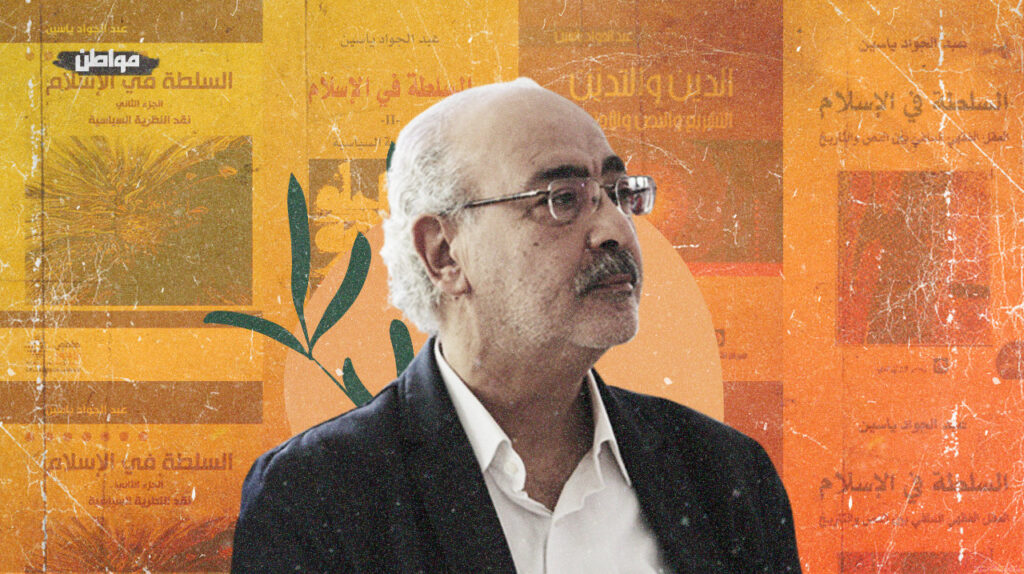
Is religion* in its entirety absolute and divine? Does what people practise as religiosity today belong wholly to the absolute divine, or does it contain both an absolute divine element and a relative social one? And if so, what is the proportion of the divine in it, and what is the proportion of the human and social? Put simply: how much of it is fixed and unchanging because it is divine, and how much is relative and open to change, allowing the human being to exercise freedom without stepping outside the framework of faith and the foundation of religion? These precise questions will form the axis of our intellectual journey with Abd al-Jawad Yassin, the contemporary Egyptian thinker, as we explore the horizons of the critique of the religious mind and the problems of contemporary religiosity, tracing the landmarks of the transition from closed tradition to a deeper and more vital understanding of the spiritual experience.
The Critique of the Religious Mind: From Spinoza to Yassin
Spinoza, the Dutch Jewish philosopher, emerged as one of the pioneers of the rational critique of religious thought in the age of Enlightenment. He offered a new reading of the sacred texts, represented by the Torah, employing the tools of philosophical reason to deconstruct traditional interpretations, affirming that sacred texts bear the imprint of human historical and cultural context. Abd al-Jawad Yassin continues this critical project, offering a contemporary reading that reveals the complex interweaving of the divine absolute and the relative social, and calling for the liberation of religious thought from the fetters of rigidity, setting it free toward spaces of creativity and emancipation.
On Method: Critique Does Not Mean the Negation of Faith
Abd al-Jawad Yassin's method in critiquing the religious mind is distinguished by the fact that it proceeds from a position of profound faith, one that believes in God and in universal morality as the essence of religion. Yet he practises a rigorous methodological critique of historical religiosity and its institutional and intellectual manifestations. He draws a precise distinction between the divine absolute, embodied in the essence of religion, and the human relative, manifested in historical practices and interpretations. This precise methodological distinction enables him to critique forms of religiosity without touching the essence of faith, and allows him to deconstruct the epistemic structures of the traditional religious mind while preserving authentic spiritual and moral values.
A Conceptual Distinction: Religion, Religiosity and Institutionalized Religion
From the outset, Yassin draws a precise distinction among three fundamental concepts:
Religion (al-din) is the divine absolute descending from a transcendent realm, whose source is pure revelation untouched by history or human beings. It is an eternal constant that does not change, embodied in the duality of God and morality.
Religiosity (al-tadayyun) represents the human practice of religion within the social and historical context, where religious experience is shaped through the human being's interaction with the sacred text, producing diversity and plurality in understanding and application.
Institutionalized religion (al-diyana) is the systemic structure formed historically, encompassing the institutions, rituals and various interpretations that society produces around religion.
Two Opposing Visions: The Religious Mind and the Social Mind
Yassin observes a profound epistemic conflict between two contradictory visions of religion:
The traditional religious mind clings to an absolutist view, considering religion to be complete divine revelation untouched by any human element. Every detail of doctrine, legislation and ritual—including subsidiary rulings—is attributed directly to God, thereby placed beyond the scope of discussion or change.
By contrast, the social mind—represented by Comte's vision—presents religion as a purely social phenomenon. It holds that religion is merely a human invention reflecting the needs and developments of society, and that science will gradually replace religion in explaining the questions of existence and the cosmos.
The Problem of the Social Mind: The Question of Faith
The social mind confronts a profound difficulty when it comes to the experience of faith. Faith is a supremely subjective matter, not subject to logical proof or objective analysis. It draws its strength from its individual particularity, which resists categorization and social analysis. It is a sacred spiritual space that traditional social methodologies cannot penetrate or decode. Hence, when this mind attempts to breach individual religious experience, it collides with an impenetrable wall of spiritual freedom. This is what renders faith—which needs no proof—an experience that no one can invade, deconstruct, or deny.
The Dilemmas of the Religious Mind: Development and Diversity
The traditional religious mind, however, faces two fundamental dilemmas of its own that shake the pillars of its absolutist understanding of religion:
The Dilemma of Development:
The greatest challenge facing the religious mind lies in the fact that religion, despite containing absolute elements, also includes a social dimension subject to the law of development. Among the most prominent manifestations of this social dimension are legislative rulings, which by their nature constitute laws influenced by temporal and spatial contexts. The mere occurrence of such legislation within a religious text does not strip it of its essential characteristic, namely its capacity for change and development. Thus, the religious mind's insistence on the fixity of legislation places it in a losing confrontation with an inescapable natural law, the law of development. This law applies to everything social within the religious text, and nothing is exempt from it except the divine absolute and the universal morality that constitute the essence of religion.
The Dilemma of Diversity:
The second challenge lies in the vast religious pluralism that reveals a fundamental truth: the religious text is not, in its entirety, absolute; rather, it contains a relative component that accommodates human variation. For how else can we explain:
The plurality among religions (Judaism, Christianity, Islam)
The diversity within a single religion (schools of thought and currents)
Individual differences in understanding and practising religion
The cultural and social diversity among human beings—encompassing languages, customs and environments—represents a universal reality that reflects the richness and complexity of human experience. This diversity, observable even within a single era, raises a fundamental question about the possibility of its being subject to a fixed text. Cultures differ in their outlook on life and their organization of societies, which necessitates that religious texts possess flexibility to adapt to the demands of this diversity. Hence, everything cultural and social within the religious text can only be relative, shaped according to specific cultural and social contexts. Only the absolute values—God and universal morality—remain constant, for they represent the essence that transcends these differences.
These two dilemmas place the religious mind before a profound epistemic impasse, requiring it to revisit its traditional understanding of the text and of religious practice.
The Essence of Religion: God and Authentic Morality
On this basis, Abd al-Jawad Yassin arrives at a fundamental vision that defines the content of religion in two essential dimensions that are not subject to change or interpretation:
Faith in God: an absolute, fixed truth that cannot be shifted or have its essence touched. It is the eternal spiritual bond between the human being and the Creator, one that transcends all human interpretations and readings.
Universal, innate morality: the authentic morality that God created within the human being in an innate and final form. It is the supreme human values that constitute the moral compass of existence, and which do not change with the change of time and place.
Everything else—legislation, rituals, and theological interpretations—belongs to the domain of "religiosity" and is subject to the laws of social development; it is not part of the essence of absolute religion. Yassin affirms that understanding this distinction is of the utmost importance, for it liberates religion from the fetters of narrow understanding and restores it to its authentic spirit: a sublime spiritual relationship between the human being and their Creator, founded upon faith and supreme morality.
Conclusion: Toward a Deeper Understanding of Religion
Abd al-Jawad Yassin calls for a radical critical reading of the religious heritage, one that transcends traditional understanding and lays the foundation for a liberatory approach to engaging with the religious phenomenon. The essence of this vision lies in:
The precise distinction between the fixed and the changeable in religion
The liberation of the human spirit from the fetters of religiosity
The restoration of the spiritual essence of religion, embodied in faith and supreme morality
It must be noted that this critical project does not aim to demolish religion, but rather to restore it to its original purity. For religion—from Yassin's perspective—is a space for spiritual and moral transcendence, not a tool of intellectual repression or excommunication.
- Religion here in the general monotheistic context (i.e., among Muslims, Christians and Jews)
** For example, the rulings concerning slavery in Islamic societies changed, moving from regulating the relationship between master and slave in juristic texts to the complete prohibition of slavery in the modern era. Another example is the development of rulings concerning methods of financial dealing, where transactions in ancient times relied on barter and metal currency, while new rulings emerged with the spread of paper currencies and banking transactions.